AI x Design
•

01
Nectar – A Fragrance Concept Captured Through Gen AI
For this project, my goal was to create a product image for a conceptual perfume called Nectar, using MidJourney 6.0. I envisioned an artistic, modern aesthetic – not an outdoor scene, but rather a high-end studio composition that incorporated natural elements like moss and greenery, with controlled lighting and a shallow depth of field, as if captured with a 100mm f/1.8 lens.
Bringing this vision to life, I styled the set with organic textures and soft botanical details, all set against a clean white studio backdrop. To add a sense of organic presence to the composition, I introduced bees, who clearly showed an interest in the perfume. Finally, I used the Kling 1.6 to animate the still image, turning it into a short, living visual.


MidJourney
Lowe – Exploring Consistency in Portraiture
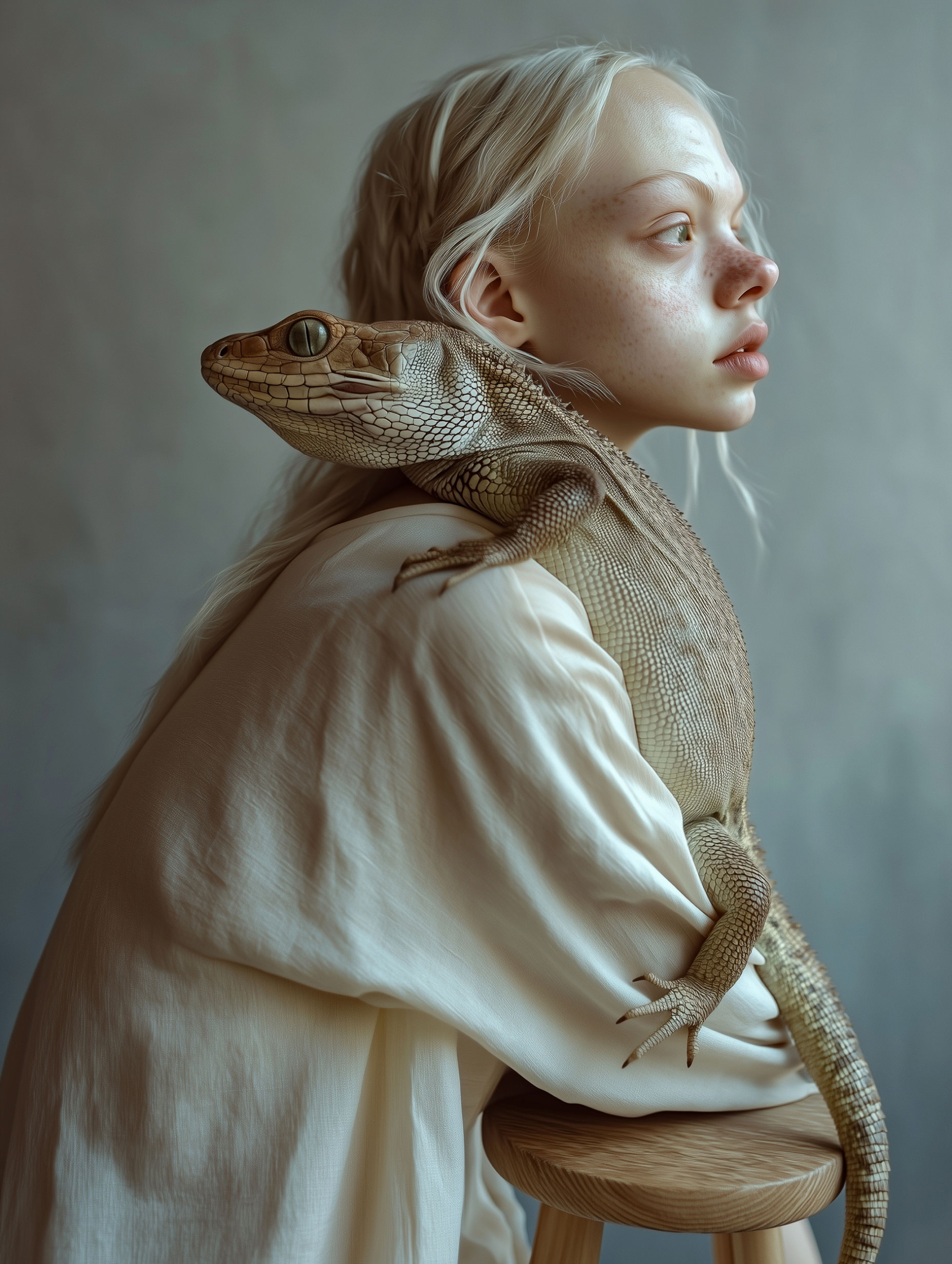
This project explores the possibilities of consistent character rendering in AI-generated imagery. Through prompt engineering in MidJourney, I developed a recurring character — Lowe — and captured her in a series of realistic portraits. The intention was to create a figure both fairytale-like and fierce, the mythical mother of reptile creatures. Rooted in fantasy, rendered in realism.
02
Lowe – Consistency in
Portaiture
In this experiment, I explored the possibilities of consistent character rendering. Through prompt engineering in MidJourney 6.1, I developed a recurring character called Lowe, a mythical mother of reptilian creatures, brought to life through a series of realistic and emotionally raw visuals.
The concept naturally developed into a contemporary, fashion-forward narrative centered around Lowe and her loved ones in various poses and settings. She emerged with distinctive features; a model-like face, a fairytale aura and a striking sense of presence.
The visual direction reflects the character, drawing inspiration from Nordic aesthetics: cold, natural light combined with a muted palette of beige tones and natural fabrics.
AI x Design
•
01
Nektar – A Fragrance Concept Captured Through Gen AI
For this project, my goal was to create a product image for a conceptual perfume called Nectar, using MidJourney 6.0. I envisioned an artistic, modern aesthetic – not an outdoor scene, but rather a high-end studio composition that incorporated natural elements like moss and greenery, with controlled lighting and a shallow depth of field, as if captured with a 100mm f/1.8 lens.
Bringing this vision to life, I styled the set with organic textures and soft botanical details, all set against a clean white studio backdrop. To add a sense of organic presence to the composition, I introduced bees, who clearly showed an interest in the perfume. Finally, I used the Kling 1.6 to animate the still image, turning it into a short, living visual.
02
Lowe – Consistency in Portaiture
In this experiment, I explored the possibilities of consistent character rendering. Through prompt engineering in MidJourney 6.1, I developed a recurring character named Lowe—a mythical mother of reptilian creatures with a distinctive fairytale aura and a striking sense of presence, brought to life through a series of realistic and emotionally raw visuals.
The concept naturally developed into a contemporary, fashion-forward narrative centered around Lowe and her loved ones in various poses and settings. She emerged with distinctive features; a model-like face, a fairytale aura and a striking sense of presence.
The visual direction reflects the character, drawing inspiration from Nordic aesthetics: cold, natural light combined with a muted palette of beige tones and natural fabrics.
03
Ascension - AI Video
In this case, I explored MidJourney’s 7.0 video feature by crafting a series of still images into a refined, sci-fi-inspired concept titled Ascension, symbolizing the act of rising up. I ensured consistency in characters and environments using omni and moodboard --p codes, fine-tuned the motion through manual prompting, and further enhanced the visuals with real-time graphics in TouchDesigner.
The concept naturally developed into a contemporary, fashion-forward narrative centered around Lowe and her loved ones in various poses and settings. She emerged with distinctive features; a model-like face, a fairytale aura and a striking sense of presence.
The visual direction reflects the character, drawing inspiration from Nordic aesthetics: cold, natural light combined with a muted palette of beige tones and natural fabrics.
Explore all Gen AI experiments on your laptop.
Generative AI explorations by Niklaz Hallberg © 2026
03
Interactive Neuroplasticity
In this work, I explore the intersection of art, creative coding and AI to generate interactive visuals and a conceptual experience. The animation, inspired by the work of Patt Vira, responds to the user’s mouse movements, enabling real-time influence over motion and flow. As the user guides the forms with their cursor, the system gradually self-organizes, revealing patterns and connections that echo the formation of new neural pathways. Try for yourself.
04
ASCENSION
In this case, I explored MidJourney’s 7.0 video feature by crafting a series of still images into a refined, sci-fi-inspired concept titled ASCENSION, symbolizing the act of rising up. I ensured consistency in characters and environments using omni and moodboard --p codes, fine-tuned the motion through manual prompting, and further enhanced the visuals with real-time graphics in TouchDesigner — complemented by a striking music loop.
05
Change Context
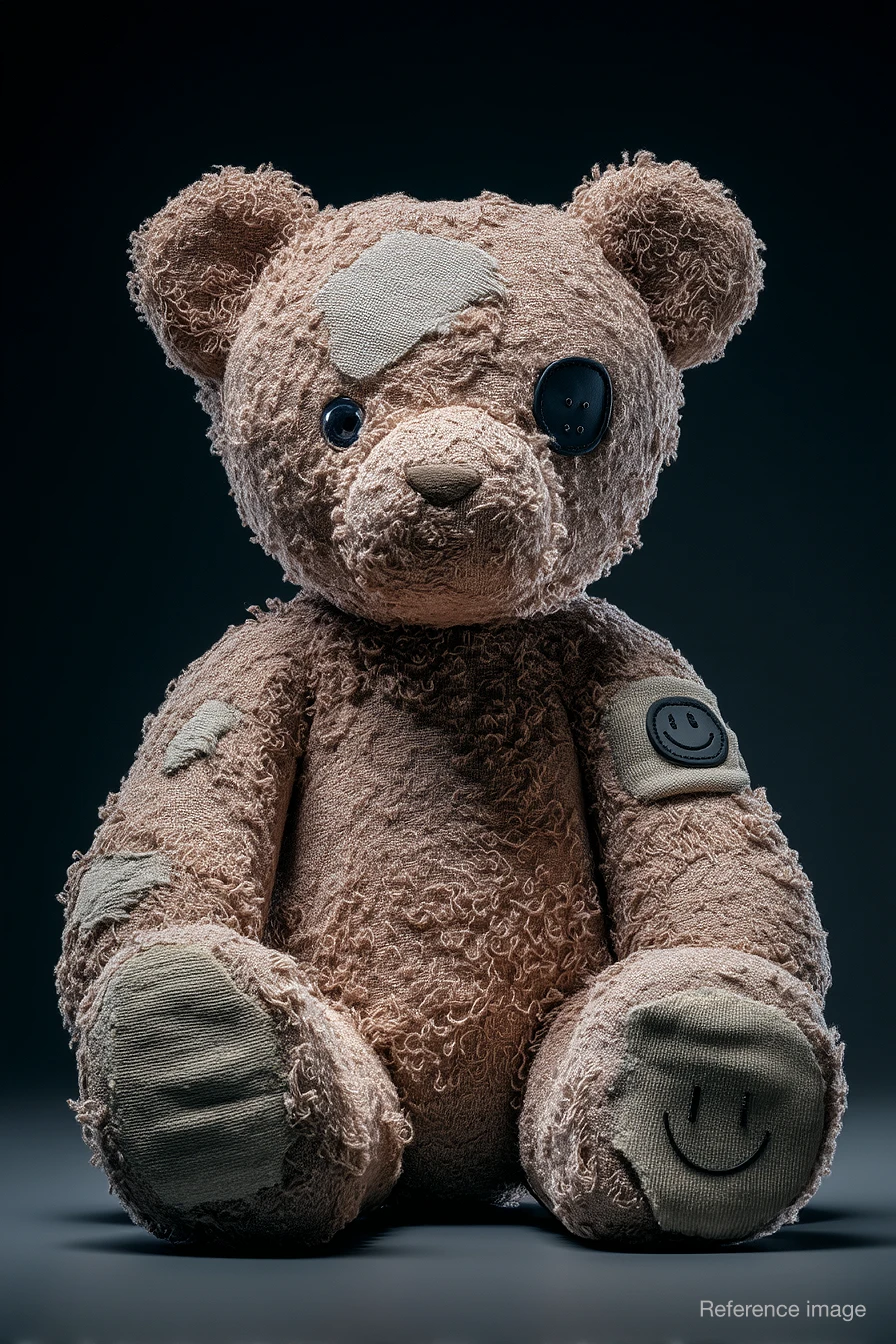
This experimentation leverages FLUX.1 Kontext, a generative model built on a next-generation Diffusion Transformer (DiT) architecture. Unlike traditional models, it interprets images with deep contextual awareness, understanding the relationship between a subject and its surroundings.
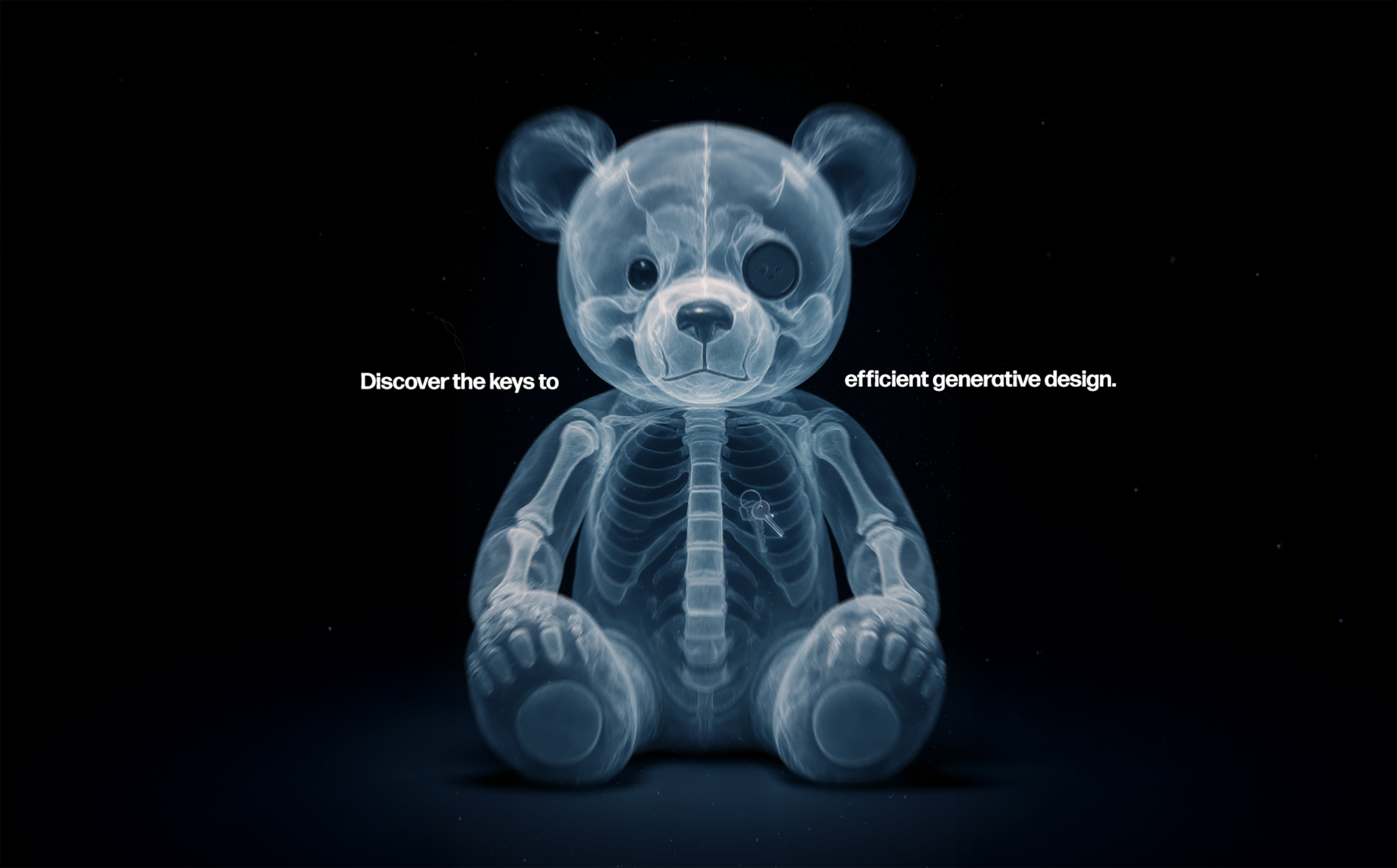
In this case, I started out by generating a slightly mysterious, worn-out teddy bear. Using it as reference, I transformed the context into an X-ray view that revealed unexpected details.
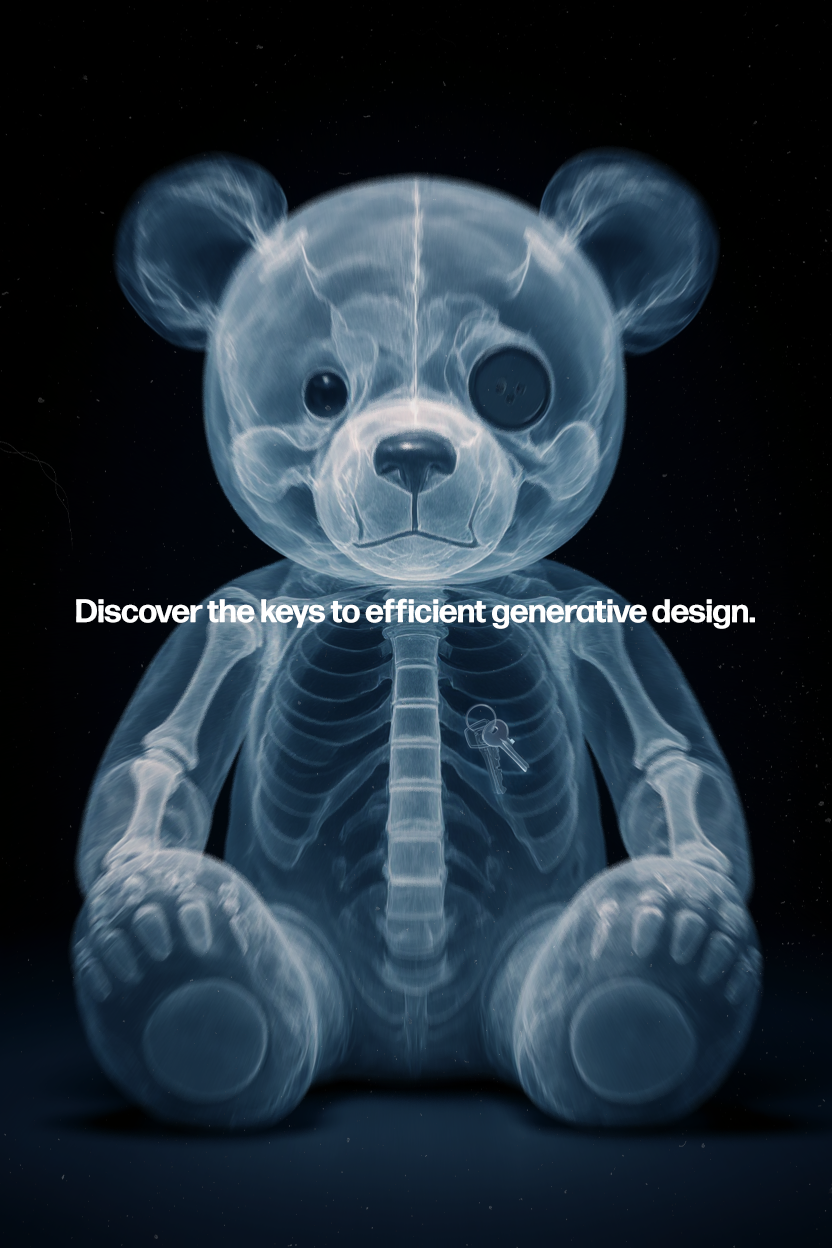
Final adjustments such as radial blur, color grading, and attached keys were seamlessly integrated in Photoshop.
TRAINING-DATA [ANIMATION 6]
06
Custom-built Gen AI model
In this project, I set out to design, build, and train a personal Generative AI model entirely from scratch using Python and the PyTorch framework.
This experiment is an advanced, technically demanding, hands-on exploration of Artificial Intelligence × Design, requiring an understanding of Deep Learning, from model architecture and data strategy to training methodology, optimization techniques, and complex problem-solving. I used Gemini 2.5 Flash as my AI co-pilot throughout the whole project.
I gathered prior knowledge in this field by studying Machine Learning and Deep Learning through MIT OpenCourseWare and IBM's AI Professional program on YouTube. After weeks of documenting, I set out to move from theory to implementation. My primary goal is to gain a deep, practical understanding of how Generative AI systems work, from concept to execution.
The model was trained locally on my MacBook using a curated dataset of 10 custom-made p5.js animations, each consisting of 180 frames. A defining feature of these animations is their seamless infinity effect, where the final frame morphs fluidly back into the first to create smooth, continuously looping visuals. My ultimate goal was to build a generative AI model that 1) learns how to accurately train on, learn from, and reconstruct frames from the training data, and 2) generates entirely new, never-before-seen looping animations in the same visual style.
All three phases are completed, with the second one: training the VQ-VAE model, being the most complex and challenging phase.
✅ Data Collection & Preparation
✅ AI (VQ-VAE) Model Development & Training
✅ Latent Space Exploration (Morphing & Generation)
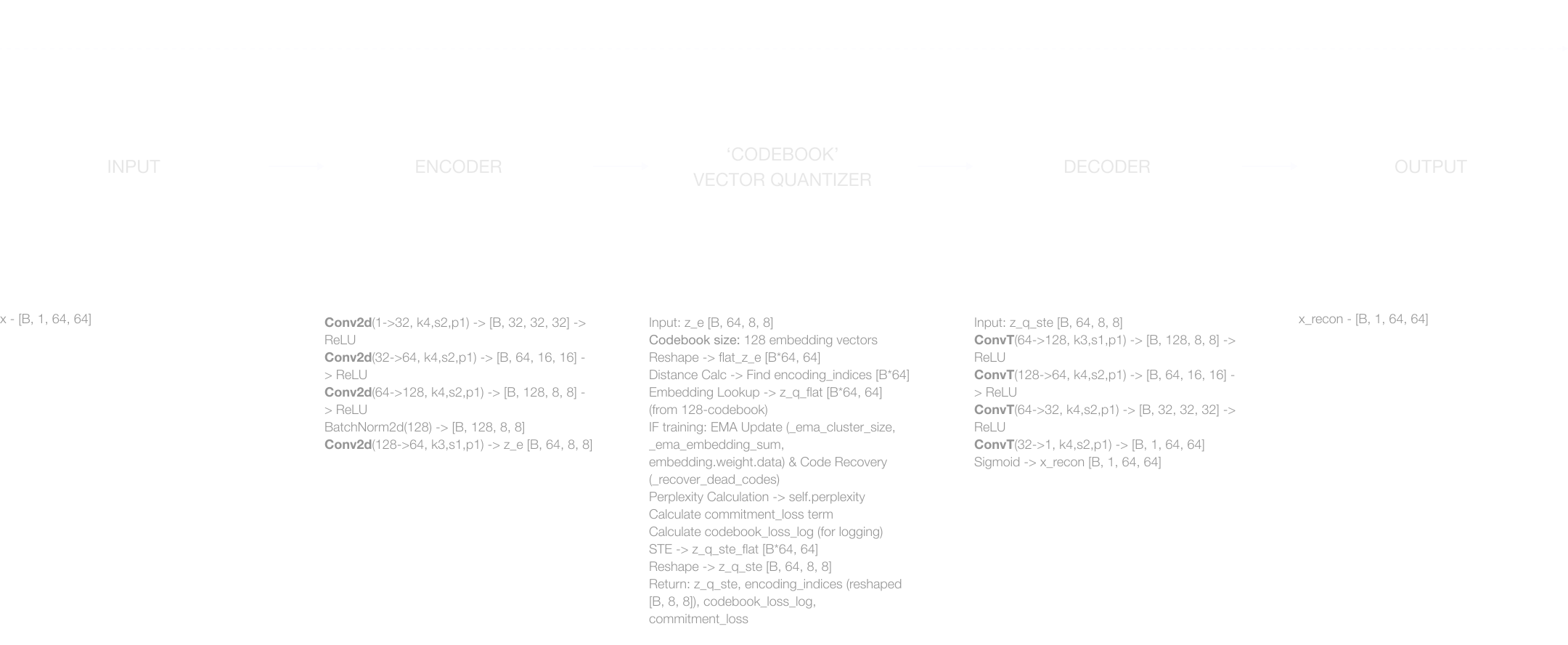
Gen AI (VQ-VAE): Model Architecture
Variational Autoencoders (VAEs) are widely used in generative design due to their ability to learn, compress, and reconstruct visual patterns. I've chosen to design a Vector Quantized VAE (VQ-VAE), a slightly more advanced architecture that, in return, produces much sharper and more coherent outputs.
Codebook Collapse
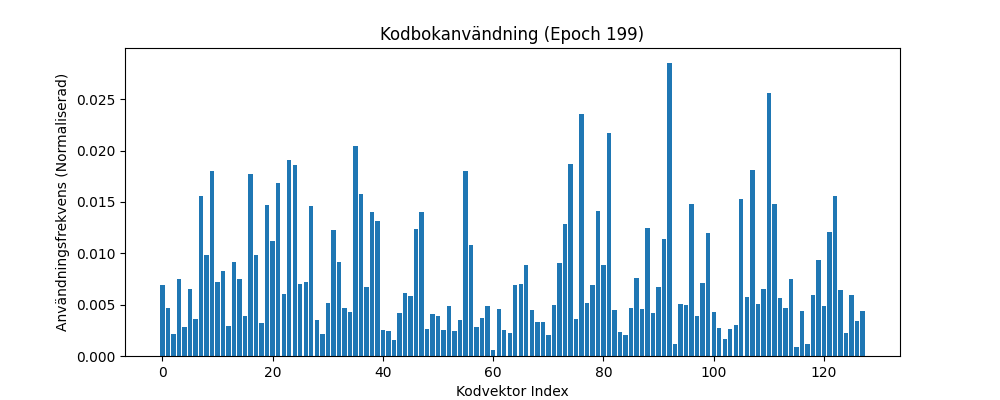
When building a VQ-VAE, it's common to encounter codebook collapse. A phenomenon where only a small subset of codebook vectors is utilized, resulting in vague or blurry reconstructions.
I experienced this firsthand: only 1 out of 128 vectors was used, producing entirely black images. To resolve it, I conducted extensive research using multiple LLMs and implemented a combination of proven techniques: KMeans initialization, Batch Normalization, and Exponential Moving Average (EMA) updates. As shown in the diagram, these changes significantly improved codebook utilization and led to more coherent reconstructions.
358,200 Iterations of Learning
The timelapse video below shows frame-by-frame output from my AI model as it learns to reconstruct input data using vector quantization. Trained over 199 epochs — each a full pass through all 1,800 frames, the model refined its ability over more than 358,200 iterations. With each epoch, it gradually improved reconstruction accuracy by minimizing error over time. What begins as noise slowly transforms into structure, the model begins to see.
Latent Space Exploration
With the model trained, the next question was: did it truly learn the structure of the animations, or simply memorize them? To find out, I built a latent walk system that interpolates between frames from different animations in the model's internal representation space, generating entirely new frames it has never seen before.
The morph video shows smooth geometric transitions between animation families. Evidence of a structured, fully working latent space. The 64×64 grayscale output to the right won't win any visual awards, but that's not the point. The fact that a custom-built generative AI model can be trained from scratch on a MacBook and still produce coherent, structured results is the real takeaway. The techniques are resolution-agnostic and scale with more powerful hardware.
This project wasn't about production-ready animations. It was about going deep into Deep Learning, building and training a generative AI model from scratch, one that learns, reconstructs, and generates its own patterns. A huge experiment, and an even bigger learning experience.
🔗 The full experiment is open-source and available on my: Github